LLD: State Managemnet and Libraries

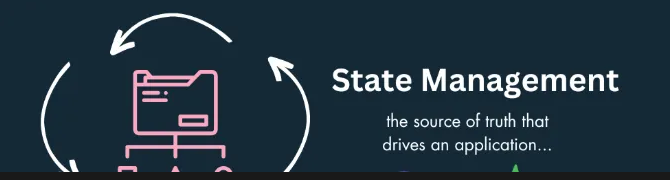
In any web app, there are two types of layers:
- UI Layer – This refers to any UI elements you see on the webpage.
- Data Layer – This is where the data is defined. It serves as the actual data source for the UI application.
The UI layer is controlled by the data layer. The data layer is responsible for everything happening in the app, including bugs and data changes.
Why Do We Need State?
Each UI element has some interactivity where data changes dynamically. To manage this changing data, we need a place to store and update it. This is where state comes in—it allows us to track and manage dynamic data in a web app.
Local State
Suppose your UI layer has cards like this (refer to the screenshot below).

In a card, we need an image source, heading, and tags, correct? Where does this data come from? It comes from a data source, which is the data layer. In a React app, this data is usually stored in the local state of the file where the card is defined using HTML or JSX.
That's why local state is needed for UI elements—it holds the dynamic data of the app to display information in the UI layer.
Props Drilling
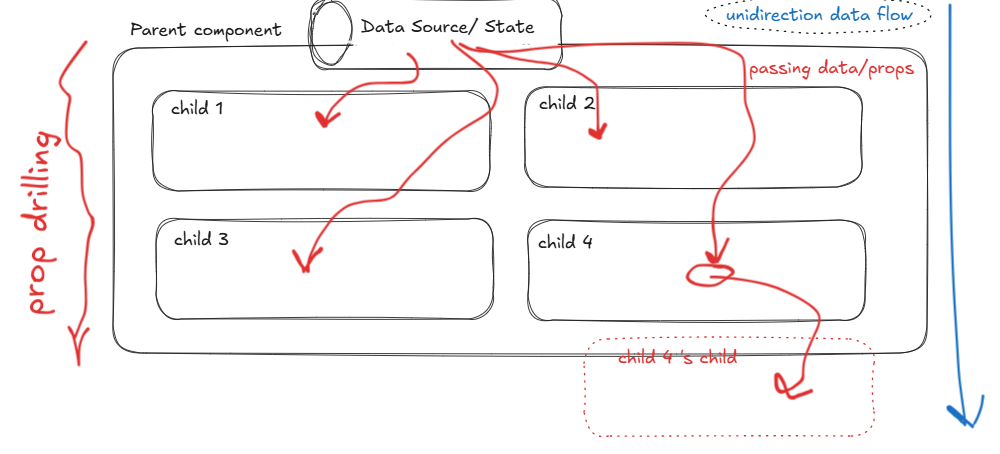
Suppose you have multiple cards managed by a parent component, and each card (a child of the parent) has more children. The cards share an identical data set coming from a single source.
To pass data to each card, the best approach is to store the data in the parent component and then pass it down to all child components instead of managing data individually in each card.
This process—passing data from parent to child to child—is called props drilling. It follows a unidirectional data flow, which is a core concept in React.
State Lifting
In React, child components cannot communicate directly with each other. This is a limitation.
Suppose Child 1 has some data that affects Child 2. If data changes in Child 1, it should also update Child 2. But since children can’t communicate directly, how do we manage this?
This is where state lifting comes in. Instead of keeping the state in Child 1, we move it to the parent component. This way, both Child 1 and Child 2 can access and modify the state through the parent.
Moving state from a child component to the parent component is called state lifting.
State Management Libraries
We manage state within local components, but why do we need libraries for state management?
In large applications with multiple pages, managing data becomes difficult due to a complex component hierarchy. Suppose data from Component A (Page 1) needs to be shared with Component B (Page 2)—passing it manually would be too complicated.
State management libraries solve this by creating a centralized store where all app data is stored. Every component reads and updates data from this store, preventing prop drilling issues.
And it's all reactive.
Reactive means that when the data changes, the component re-renders automatically to reflect the updated state.
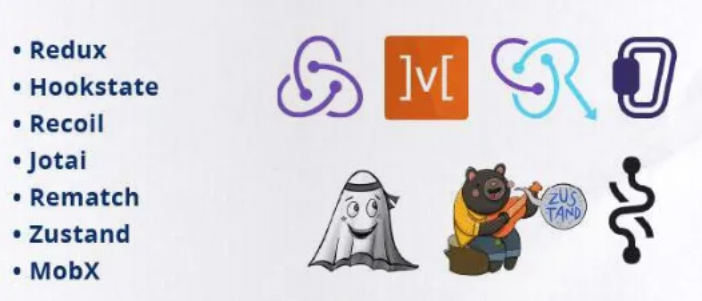
Each framework has its own state management libraries. For React, I have attached a screenshot you can refer to below.
Context API
Remember: State management libraries are only required for medium and large-scale projects, not for small projects.
For small-scale projects, you can use local state and props drilling. However, React provides another built-in feature that allows you to share data across components without installing any third-party library—this is the Context API.
With Context API, you can define your data in the root app or any specific component, making it accessible to all components page-wise or as needed.
Want me to write notes on a course?
Tell me the course, book, or research topic you want covered. If it helps learners, I'll consider adding structured digital notes for it in the garden.
Have a notes collection to feature here?
Do you have open notes you want featured in this digital garden? Let me know — we can collaborate and publish them for learners worldwide.
Having a doubt? Ask a query?